
Contents
How has engagement been impacted?
Why was employee engagement impacted more in some organisations, whereas some impacted organisations managed to sustain engagement?
What are the most important things for organisations to do to sustain engagement through change?
In 2025, the US AID stoppage affected many of our clients from NGOs and multi-laterals in the humanitarian and global development sector, as funding cuts hit their organisations and programmes.
Many clients delayed their usual employee listening, in order to deal with the impact of this, but in the last few months of the year we were seeing more and more organisations in the sector initiating employee surveys. As we have been presenting 2025 and 2026 survey results back to clients, we have found people asking questions about what the impact of the events of 2025 has been on engagement across the sector, to help put their own results into context.
In this article we share insights and trends from employee engagement surveys of NGOs and multi-laterals in the humanitarian and global development sector over the past 14 months. The results specifically focus on how funding cuts have impacted employee engagement.
Between February 2025 and March 2026, we ran surveys for 21 INGOs and multi laterals who had a comparison to an engagement survey they ran prior to February 2025, so we can ascertain whether engagement has changed. Out of the 21 organisations, 10 of them were directly impacted by the US AID stoppage, whilst 11 were not.
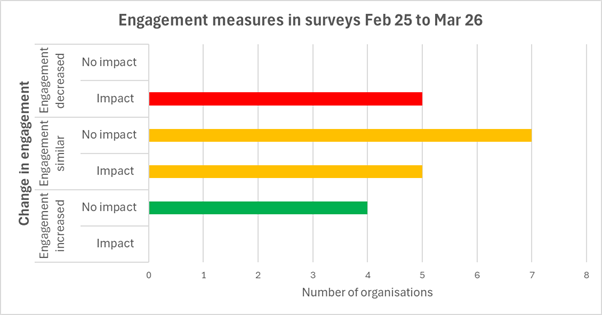
NB similar is less than five percentage points increase or decrease. “I would recommend this organisation as a good place to work” is the engagement measure used for comparison
Engagement fell in 24% (5) of the 21 organisations. All five of the organisations with significant falls had experienced direct impact and the decreases ranged from 11 to 40 percentage points.
Engagement did not change significantly in 57% (12) of the 21 organisations. Five of these organisations had experienced impact and seven had not.
Of the 10 impacted organisations, half had significant decline in their engagement and half stayed similar.
For the 11 organisations who did not experience direct impact of the cuts, engagement stayed similar in 7 of them and increased in 4 of them
We can conclude that the experience of funding cuts was a significant challenge for employee engagement in the organisations affected, with unaffected organisations generally able to maintain or improve positivity amongst staff
Engagement increased in 19% (4) of the 21 organisations. None of these organisations had experienced impact and the increases ranged from 6 to 34 percentage points.
Why was employee engagement impacted more in some organisations, whereas some impacted organisations managed to sustain engagement?
To help us think about this we looked back to data from 24 INGO engagement surveys between 2023 and 2024 to see the questions that generally have high impact on engagement in INGOs.
Questions in the Leadership category often have high impact on engagement – these are the highest impact questions:
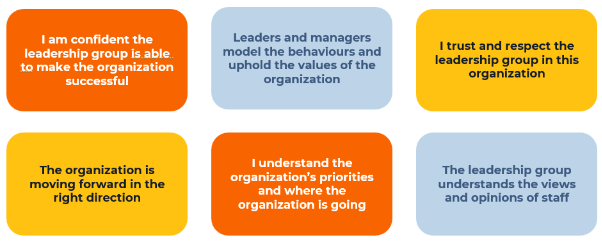
During change, it is more difficult for leaders to maintain positivity on these measures as people experiencing negative impacts will hold leaders responsible for what is happening, and change can often cause confusion and misunderstanding. To help maintain engagement with staff, leaders need to have a focus on dialogue and communication so that staff understand better the challenges the organisation is facing and how leaders are working through the decisions they must take.
Questions in the Culture and Values category often have high impact on engagement – these are the highest impact questions:
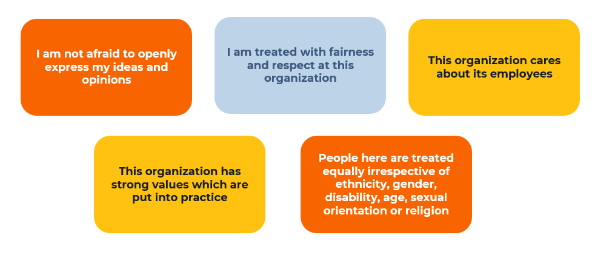
During rapid change at an organisation, values and culture become even more important than in ordinary times, as pressure can erode them and this is likely to lead to lower staff engagement. Showing that an organisation still “lives the values” in these moments is crucial.
When we discussed this with a group of People and Culture professionals in the sector at a Humentum webinar at the end of April, we found that similar themes came up when people talked about what they felt had been the most important responses during the period to help staff to cope and maintain focus and engagement. We heard that the “people first attitude of leaders” was the important thing in their organisation, helping them to pull together and work through the implications of the cuts. The leaders in the organisation showed strong leadership and listened to the People and Culture team to guide their actions and communications.
“Communication is key” was a mantra for leaders in affected organisations, with strong leadership groups making sure they communicated with staff a lot during the period. As was a strong commitment to “living your values” - acting as human-centered organisations who care about the wellbeing of staff.
We also heard from affected organisations that people leaving due to lay-offs leads to an impact on engagement and burn out for those who still work at the organisation as they try to fill the gaps. To help counter this, people highlighted the importance of identifying and discussing this issue, and then working through the consequences to decide what the key commitments are and focus where resources go so that the people still in the organisation are not overwhelmed.