

Contents
The question every leader actually wants answered
Why video puts you back into the room
What this looks like in practice
The leaders who get this right, move faster
Book a Dialogue demo
Run a single site, and you know things without asking. You walk the floor. You catch the sigh after a tough shift, the joke that tells you morale's fine, the sideways glance when a new process isn't landing. You don't need a survey to tell you what's going on, you're standing in it.
Run 600 branches, or 60 depots, or a network of sites your people never see you walk into, and all of that disappears. Not the problems. Just your view of them.
That's the real cost of scale for dispersed organisations with frontline employees and multi-site leaders. It's not a data problem. It's a proximity problem. You've lost the ability to see and hear the people running your operation, and you're left reconstructing what's happening from whatever thin signal makes it back to you, a quarterly survey score, a summarised report, a dashboard of sentiment with no faces attached to it.
Most leaders don't miss the data. They miss the people.
The question every leader actually wants answered
Somewhere in your organisation right now, a frontline employee has a better read on a broken process than anyone in your leadership team. They know why customers are frustrated at 4pm on a Friday. They know which part of onboarding makes new starters quit in week two. They know what would actually make their day-to-day operations easier, and by extension, make the business run better.
You want to hear that and in detail. Not a paraphrased, aggregated, three-months-later version of it. Them, saying it, in their own words.
That's what a text box can't always give you.
A summary score tells you that something's wrong. It never tells you what it's like to be the person living it, the tone, the frustration, the pride, the specific detail that makes a problem real instead of a number on a chart. You lose all of that the moment feedback gets flattened into a rating scale.
Why video puts you back in the room
Video and voice do something distinctive: they put you back in the room.
When an employee records themselves answering your question, unscripted, you're not reading about their experience, you're watching it. You hear the hesitation before they say something honest. You see their face when they talk about a win, or the flicker of frustration when they talk about what's not working. None of that shows up in a data point, it's tone, timing, expression, the small human cues that carry as much meaning as the words themselves. That's richness you can't get from text: a fuller, truer picture of what people actually feel, not just what they typed.
And it works both ways. When you, as a leader, show up on video, asking a real question, in your own voice, without a script — your people feel that too.
In a workplace increasingly full of AI-polished comms, a leader speaking plainly on camera reads as exactly what it is: a real person, actually asking, actually listening. That human-to-human moment, someone showing up as themselves and someone else responding in kind, is what earns the honest answer back. It's not just more information. It's a real connection, at a scale that used to be impossible.
What this looks like in practice
WorkBuzz Dialogue exists to make that kind of connection possible at scale, without asking leaders or employees to be in the same room. A leader records a short, direct video question and sends it straight to their workforce. Employees respond however feels natural, video, voice note or text. AI distils the responses into clear themes, so a leader can absorb what tens, hundreds or thousands of people are telling them in minutes, not weeks.
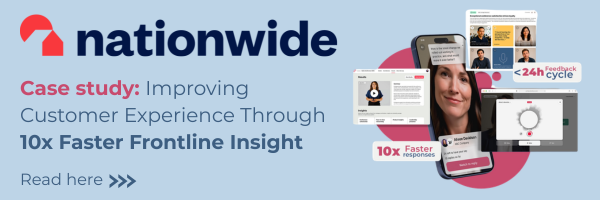
Nationwide put it into practice across more than 4,000 colleagues in over 600 branches and contact centres. The point wasn't the format, it was what leaders could suddenly see and act on:
- 10x faster speed-to-insight than their existing process — leaders knew what mattered while it still mattered
- 21% better participation than Microsoft Forms — because people will talk to a person before they'll fill in a form
- 2.5x deeper insight from video responses compared to text alone — the difference between knowing a problem exists and understanding it
Leaders closed the loop in under 24 hours. Employees didn't just get asked, they watched their answer turn into action. That's the moment trust gets built: not the question, but the response to the response.
The leaders who get this right, move faster
Surveys aren't going anywhere, and they shouldn't, they're still the right tool for tracking sentiment over time. But between survey cycles, in the moments that shape engagement, retention and operational performance, leaders need something faster and more human.
The leaders who close that gap first won't just have better data. They'll have people who feel genuinely heard, operations that improve in days instead of quarters, and a connection to their frontline that scale was never supposed to allow.
Everyone else will still be waiting on the next survey to find out what already happened.
Find out more about Dialogue at workbuzz.com/dialogue.
¹ SQ Magazine: Social Media Screen Time Statistics
² StandOut CV: Social Media at Work Statistics UK