

The pandemic forced remote working on the world and accelerated change that could have otherwise taken a generation to happen. As we adapt to post-pandemic working, we see many organisations struggling with attrition and retention. This has led organisations to move towards flexible hybrid working.
The benefits of flexible hybrid working are vast. Some of these benefits include: a better work-life balance and the ability to juggle home life more effectively; greater scope to concentrate on key tasks; the financial and personal benefits of saving on transport costs and stress; and more scope for diversity in hiring.
However, now that hybrid working has become embedded, what is also becoming evident is that hybrid comes with new challenges. It imposes a lack of human connection, and fewer learning opportunities. As well as this, there is the expectation to be ‘always’ on, and the risk of a two-tier culture that needs to be balanced with the benefits of hybrid.
It’s important that this new way of working works for everyone if you’re to remain united as a team and thrive as a business. So, what can HR do? In the following article, we’ve put together 5 tips for how to manage hybrid working.
Firstly, understand that flexible working is no longer a unique benefit
For many office-based roles, flexibility around how, where and when employees work is no longer a differentiator; it is an expected given. But is hybrid really as simple as the ability to either work from home, your employer’s workplace, or wherever you want? What is the lasting change your organisation wants to create?
Many employees have looked, or are looking, to restructure how they spend their time. This is with the goal of creating a work life balance that resonates with their new personal priorities. In addition, there are signs that more organisations are considering adopting the four-day working week to attract and retain talent.
Create a flexible working policy that’s individual to everyone
Our 2022 survey shows that the majority of office-based employees spend two to three days a week in the office and just 3% of organisations have gone fully remote. What many organisations are finding, is that the choice of location for current and future work is being driven by the task in hand.
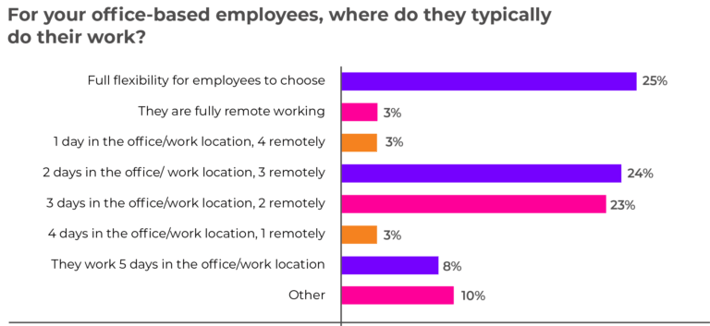
For example, if you need solitude to do analysis or write a report, the optimal work location might be at home. If you need to collaborate with others, the work location will be the work environment in order to tap into the interaction and innovative creative spark that we only get when we’re with others.
Avoid falling into a ‘them and us’ culture
Building a workplace that’s equal can become a little complicated when managing a hybrid working team. So as an HR leader, it’s important to put general practices in place to counteract this.
Firstly, it’s important to ensure that managers don’t treat those that work on a hybrid basis – or even those that work remotely – any different to office-based team members. Make sure that leaders are making a clear effort with those that visit the office less frequently. And make sure that they are providing ample opportunities for these workers to weigh in on projects. Where someone works from shouldn’t become a barrier to how frequently they’re conversed with or offered support.
The feeling of detachment from others from hybrid or remote working can be prevented further by encouraging colleagues to build relationships proactively with one another. This can be through weekly team calls or biweekly online socials. At WorkBuzz, we use a Slack integration tool – Donut – that unifies those working from outside of the office by facilitating human connection.
Communicate in the right way
Communication plays a large part in how effective hybrid working is. Encourage teams to discuss their preferred methods of communication and to get some general practice guidelines set in stone. For example, how often should their team meet and why? How is best to share location updates like annual leave and when people go for lunch? What information should be shared where?
Pay attention to signs of burnout
When moving a workforce to hybrid work, you need define how leaders are going to deal with different situations. Through the transition to hybrid working and beyond it becoming the ‘norm’, it’s specifically important to pay attention to individual stress levels. Humans get stressed for all types of reasons. But it’s critical for leaders to notice when an employee is behaving differently since a change in work-style. If the employee reports feeling overwhelmed, it’s important as a leader to help them get organised, provide support, or clarify certain tasks that may have been communicated inefficiently.
This article contains a snippet from our 2022 report on The State of Employee Engagement. This report draws on insights from our 400+ clients at WorkBuzz and research conducted with 300+ people and business leaders. It outlines their top priorities, best practices, and different perspectives to help you navigate an ever-changing world of work. Download the full version of the report here. You can also view all our other eBooks available to download here.
Keep going further
 Business & Professional Services
How to reach and engage employees in business and professional services
There are unique employee engagement challenges for business and professional services organizations, with employees often located in different offices – or working from home – and fulfilling vastly different roles. Organizations must use innovative strategies to ensure their workforce is engaged, motivated, and productive.
 Business & Professional Services
5 ways to improve employee engagement in business and professional services
Employee engagement is a critical factor in the success of any organisation. And, with 44% of people working in business and professional services saying they’re open to new job offers – up from 39% in 2021 – organisations must take active steps to improve engagement before it’s too late.
 Business & Professional Services
4 key people challenges in business and professional services – and how to fix them
As business and professional services continue to evolve, HR leaders are increasingly facing more complex challenges when it comes to managing their employees and need the skillset and agility necessary to keep up with their demands.
Nothing here yet for this topic — check back soon.