Quick Links
-
Remove the manual analysis that drains HR capacity
-
Turn insight into action — without HR doing all the chasing
-
Support managers at scale (without endless training sessions)
-
Strengthen HR’s influence with the executive team
-
Protect HR wellbeing — so they can protect everyone else’s
Final thought: AI isn’t the future — it’s the relief valve
HR teams are exhausted — and the data proves it.
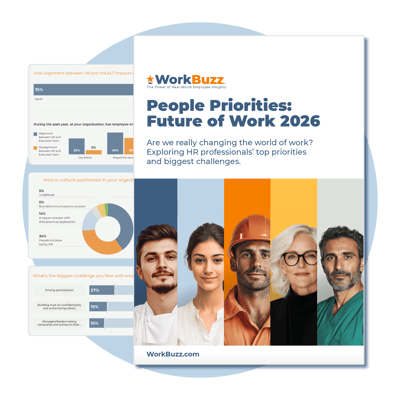
According to the People Priorities: Future of Work 2026 report, 53% of HR professionals have felt under constant strain over the past six months, with workloads increasing while team sizes shrink
At the same time, HR is being asked to lead wellbeing, engagement, culture, change and productivity — often with fewer people and less time.
That’s not sustainable. And it’s why AI isn’t a “nice to have” anymore.
Used well, AI doesn’t replace the human side of HR — it protects it. By taking admin, analysis and repetition off HR’s plate, tools like People Science AI create the space for HR to do what matters most: influence strategy, support managers and improve employee experience.
Here are five practical ways AI can help save HR from burnout — and restore strategic impact.
-
Remove the manual analysis that drains HR capacity
Employee listening is essential — but analysing the data can be exhausting.
Free-text comments, multiple demographics, pulse surveys layered on top of annual surveys… it all adds up. The report shows that shrinking HR teams are already listening less frequently, with many organisations reverting back to annual surveys simply because they don’t have the capacity to manage more
This is where AI makes an immediate difference.
AI-powered analysis can:
- Identify key themes and sentiment in minutes, not weeks
- Surface emerging risks before they become engagement or wellbeing issues
- Eliminate hours of manual coding and spreadsheet work
People Science AI, for example, automatically uncovers the “why” behind employee feedback — turning raw data into clear, prioritised insight without HR having to wade through thousands of comments.
Result: less time analysing, more time acting.
-
Turn insight into action — without HR doing all the chasing
One of the biggest sources of HR burnout isn’t listening — it’s what comes after.
The report highlights a trust gap: when employees don’t see action taken, participation drops and surveys lose credibility
But with limited capacity, HR can’t realistically own every action plan across the business.
AI helps shift that burden.
By generating team-level insights and suggested actions, AI-powered tools enable:
- Managers to see exactly what matters most to their teams
- Faster, clearer ownership of action at local level
- Less manual follow-up and firefighting for HR
When action planning is automated and embedded, HR moves from project manager to strategic enabler.
Result: visible action without HR burnout.
-
Support managers at scale (without endless training sessions)
The research is clear: poor communication and change management are major drivers of disengagement and strain— for employees and HR
Managers play a critical role here, but many lack confidence or clarity. Traditionally, HR fills the gap with workshops, toolkits and repeated reminders — all of which take time HR doesn’t have.
AI changes the equation.
With personalised, insight-led guidance, managers can receive:
- Clear summaries of what their team is saying
- Practical, prioritised actions tailored to their context
- Ongoing nudges that reinforce accountability
This reduces dependency on HR while improving leadership capability where it matters most: day-to-day conversations.
Result: better managers, less pressure on HR.
-
Strengthen HR’s influence with the executive team
One of the strongest findings in the report is the link between HR–ELT alignment and engagement outcomes. Where alignment is strong, engagement and wellbeing are more likely to improve. Where it’s weak, fewer than 10% of organisations see engagement rise
AI helps HR speak the language of the boardroom.
By producing clear, executive-ready summaries, AI enables HR to:
- Connect employee feedback directly to business priorities
- Evidence risk, opportunity and progress with confidence
- Spend less time reporting, more time influencing
Instead of drowning in dashboards, HR can focus on storytelling — turning insight into strategic conversation.
Result: HR seen as a driver of strategy, not survey admin.
-
Protect HR wellbeing — so they can protect everyone else’s
The report doesn’t sugar-coat it: HR can’t pour from an empty cup.
With 65% of HR professionals citing “too much to do” and 60% saying they don’t have enough people, burnout isn’t a risk — it’s already here
AI won’t solve every problem. But it can:
- Reduce cognitive overload
- Remove repetitive, low-value tasks
- Create breathing space in overstretched teams
Crucially, it allows HR to refocus on the human work that gives the role meaning — connection, judgement, empathy and leadership.
Result: sustainable impact, not survival mode.
Final thought: AI isn’t the future — it’s the relief valve
The People Priorities: Future of Work 2026 report shows that HR appetite for AI exists — but adoption is still slow, largely due to lack of time and expertise
That’s the paradox: HR needs AI because it’s overstretched, but being overstretched makes AI feel hard to adopt.
The solution isn’t experimentation for experimentation’s sake. It’s using proven, purpose-built tools that reduce workload from day one.
AI doesn’t replace HR’s value.
It protects it.
And in a world of constant change, that might be the most strategic move HR can make.