Contents
The gap between intention and reality
Why are we still struggling?
Leadership, communication and confidence
How should AI factor in the world of work
Employee listening only matters if action follows
HR can’t change the world of work alone
So… are we changing the world of work?
For decades, organisations have invested heavily in engagement surveys, culture initiatives and employee value propositions. We measure sentiment, benchmark scores and publish dashboards filled with data points. But there’s an uncomfortable question we don’t ask often enough:
After all this effort, does work actually feel better for the people living it every day?
If we look honestly at the signals coming from today’s workforce, the answer is far from clear.
The gap between intention and reality
Confidence in senior leadership is at one of its lowest points in recent memory. Anxiety about the future of work, particularly the impact of AI, is rising. Younger generations are reporting higher levels of loneliness, depression and anxiety. At the same time, managers, HR and people teams are under intense pressure, juggling constant change with shrinking resources and an ever-expanding remit.
This isn’t what the “future of work” was supposed to look like.
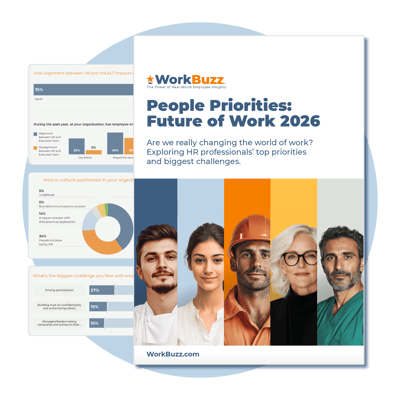
WorkBuzz’s People Priorities: Future of Work 2026 research reinforces this disconnect. While employee wellbeing (44%) and engagement (35%) remain HR’s top priorities, engagement outcomes are stagnating. In 2025, only 33% of organisations reported improved engagement, down sharply from 58% the year before. Nearly half say engagement has stayed the same, and 16% believe it has declined.
The uncomfortable truth? Talking about culture isn’t the same as changing it.

Why are we still struggling even with employee listening?
When we dig beneath the surface, a pattern emerges. Many of the challenges facing employees aren’t new, they’re persistent, systemic and deeply human:
- Unsustainable workloads and constant change
- Poor communication during transformation
- Inconsistent leadership behaviours
- A lack of trust that feedback will lead to action
One of the most significant factors is misalignment between HR and executive leadership.
The research shows that where HR and the ELT are aligned and trust each other, employees are far more likely to experience higher engagement and wellbeing. Where misalignment exists, fewer than 1 in 10 organisations see engagement improve, and almost 50% report a decline.
When priorities clash at the top, employees feel it everywhere else.

Leadership, communication and confidence
Leadership behaviour remains one of the strongest predictors of how work feels day-to-day.
Employees consistently tell us they want leaders to:
- Communicate change more clearly and consistently
- Act as visible role models for values and behaviours
- Recognise good work and positive contribution
- Explain why decisions are being made, not just what is changing
Yet communication is also where leaders struggle most.
WorkBuzz data shows that where internal communication is effective, confidence in leadership is 58 points higher. Where culture is treated as a vague or abstract concept, engagement is more than three times more likely to decline.
Culture doesn’t live on walls or intranets. It’s shaped, every day, by how leaders communicate, listen and act.
How should AI factor in the world of work
AI is often positioned as both a threat and a solution. Employees worry about what it means for their roles, while HR leaders recognise its potential to reduce workload, increase insight and free up time for more human work.
The challenge is adoption.
Although 69% of organisations are experimenting with AI, fewer than 20% say it meaningfully shapes how work gets done. A lack of internal expertise, limited capacity and understandable caution are holding progress back.
And yet, the opportunity is significant.
Used responsibly, AI can:
- Reduce manual data analysis
- Surface patterns in employee feedback faster
- Support managers with clearer, more focused actions
- Free HR teams from constant firefighting
Tools like People Science AI are already helping organisations turn listening into action, translating vast amounts of feedback into insights leaders can actually use.
The question isn’t whether AI belongs in HR. It’s whether HR is being supported to lead its adoption in a way that genuinely improves work.

Employee Listening only matters if action follows
Employees haven’t stopped caring about being heard. They’ve stopped believing it will make a difference.
Survey participation is falling, with more organisations reverting to annual surveys as HR teams shrink. This creates a dangerous cycle: less listening leads to less trust, which leads to even less engagement.
The research is clear:
- 60% of employees cite unsustainable workloads as the biggest barrier to wellbeing
- 34% point to constant change
- When wellbeing improves, 92% also report stable or improving engagement
Listening must be continuous, visible and followed by action at team level. Otherwise, it becomes another broken promise.
HR can’t change the world of work alone
Perhaps the most sobering finding is the state of HR itself.
HR professionals report feeling under constant strain; workload, shrinking teams and rising expectations are the precursors of burnout, this affects the ability to improve the experience of others, which is fundamentally compromised.
HR can’t pour from an empty cup.
To genuinely change the world of work, organisations must:
- Invest in HR capability and capacity
- Share ownership of employee experience with leaders and managers
- Use technology to remove friction, not add complexity
- Treat communication as a strategic capability, not an afterthought
So… are we changing the world of work?
Not yet. But we could be.
The data doesn’t point to a lack of intent, it points to a lack of alignment, follow-through and focus on what truly shapes daily experience.
When organisations get three things right, the difference is tangible:
- Strong, two-way communication
- Confidence in leadership behaviours
- Clear ownership of employee experience
Changing the world of work doesn’t start with another survey or slogan. It starts with honest reflection, shared accountability and the courage to act on what people are really telling us.
Only then does work begin to feel like somewhere people can find purpose, meaning and fulfilment, not just productivity.
If you want to explore the data behind these insights, download the People Priorities: Future of Work 2026 report and discover where HR and leaders can focus next to make a measurable difference.